
|

|

|
|
|
|
|
| Home | Manuals | Supplies | Search | Consult | Contact | Testing | Service |
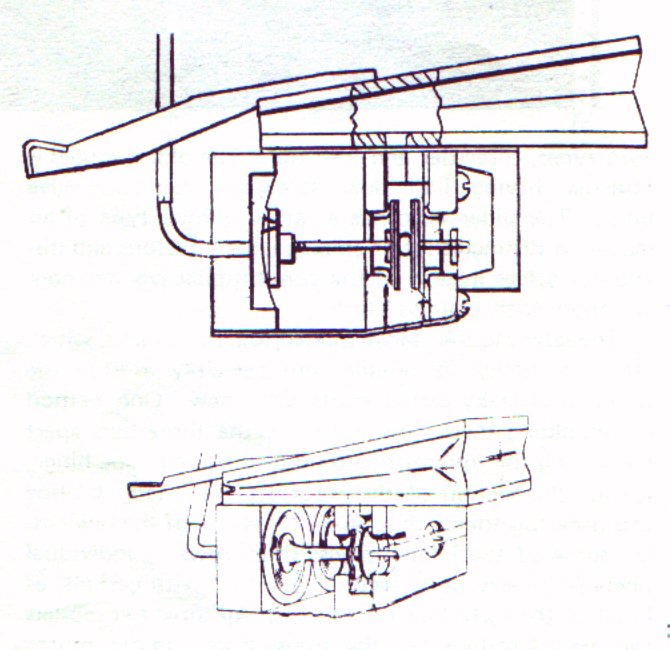
Basically, identification of Baldwin player actions is through piano names: Baldwin, Ellington, Franke, Hamilton, Howard, Manualo, Melbourne, Modello, Monarch, St. Regis, Sargeant, Schroeder, and Winton. The player action was not sold outside the "House of Baldwin" line. Both two and three-tier types were made. More common is the three-tier. Most have automatic tracking, with the large tracking ears rising from the tracker bar cover. The Baldwin tracker bars usually have extra high tracker bar holes with 11/64" nipples. Horizontal valves in the three-tier stacks were centered by resting in the center hole of a mushroom-shaped wood turning, with the head glued directly to the pouch leather around a hole in the leather which exposed the vent disc. It was a straight-through shot to gain access to this vent for cleaning, by removing the brass elbow from the rear. The front of the wire valve stem was held up by a wooden guide strip across the outside valve hole in the three sectional cover plates of the valve wells. The pneumatics face the front with a long wooden lever across the hinge end, which allowed compound leverage, compensating for the smaller size of the pneumatics. This engaged directly to the metal catch on the abstract of the piano action at each level. The lack of a common guide rail makes it necessary to draw a pencil line around the wooden pneumatic fingers on a template, referencing to the end of the pneumatic stack on each row before removing any pneumatics. Otherwise you would be in serious alignment trouble in again replacing same. The player stack is ingenuously simple and cheaply made. It is lightweight. The two main boards use spacers and this skeleton is closed from both sides with a strip of light bellows cloth. Although there is no mention of it in the service manual, it has been documented that Baldwin changed the design of the Tempo Control Box at some point in production. In the later model, there are five calibration points instead of just three. Based on the information in the manual about the three calibration points (40-70-100), it is this authors opinion that the five calibration points were 20-40-60-80-100. Also, later models have a vacuum switch which is mechanically connected to the Play/Rewind lever, near the transmission. This switch is used to control a pouch and valve (in the tempo control box) which opens a relatively large vacuum port that provides the vacuum for Fast Reroll. In the earlier model, this function was handled mechanically via some elaborate linkage. |
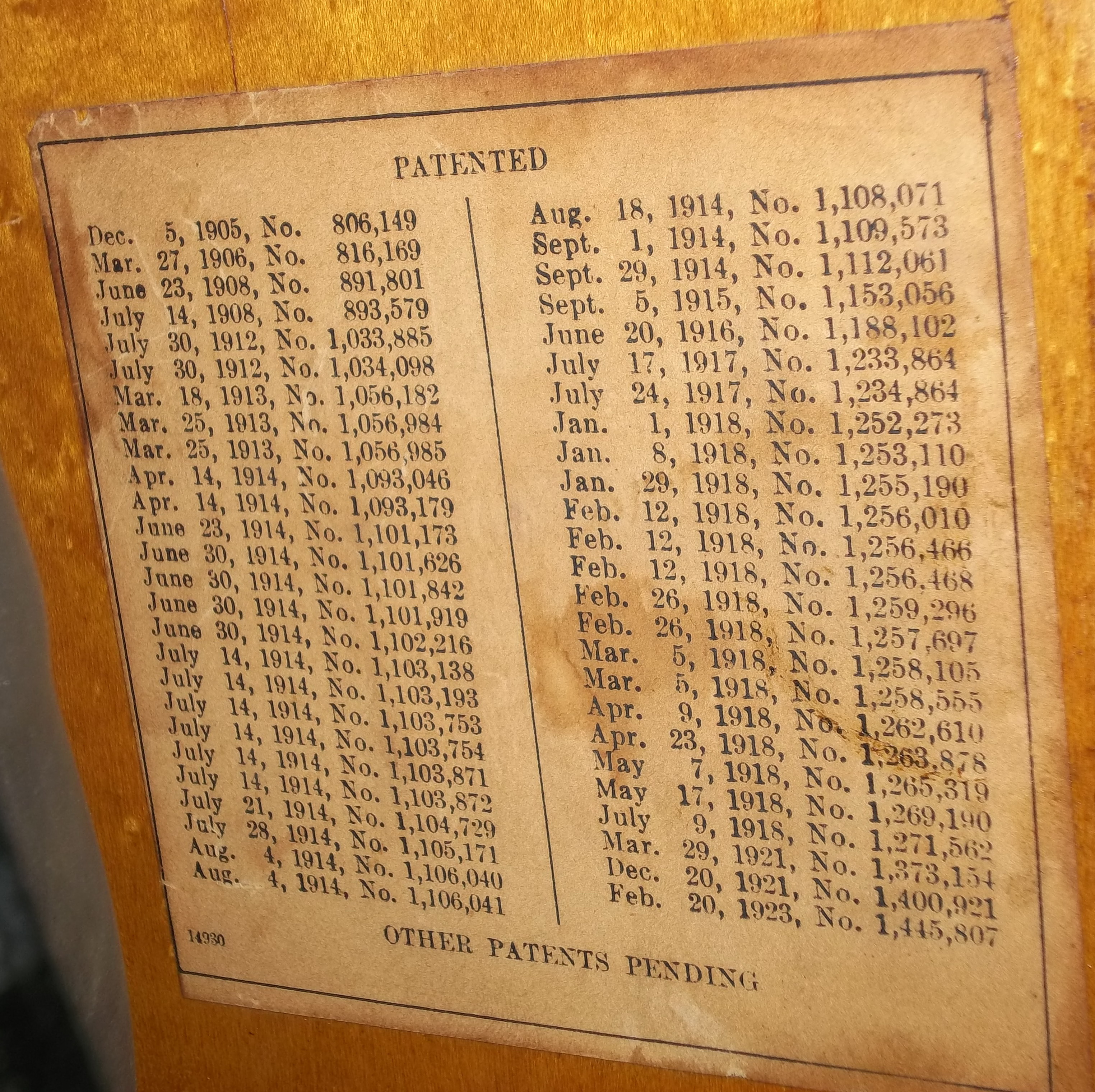

Listing of Baldwin Patent Numbers from December 27, 1904
through February 20, 1923
Click Here to view the Baldwin Patents.
|
Since "Player-Care" is an internet business, I prefer that we correspond via E-Mail (click here to fill out the 'Request Form'). However, if I'm not in the middle of some other activity, you can reach me at 732-840-8787. But please understand that during the hours from 8AM-5PM EST (Mon-Sat), I'm generally quite busy. So, I probably won't answer the phone. If you get the answering machine, please leave a detailed message stating the reason for your call. Also, repeat your name and phone number clearly and distinctly. By necessity, I prioritize everything in my life. And, if you call and just leave your name and number, and ask me to call you back, it might be a day or two before I return your call. Why? Because I don't know why you want me to call and I might not be prepared to assist you in an effective and efficient manner. If you leave me an E-Mail address (which I prefer), spell it out phonetically. The more you do to help me, the more I can help you in return. Don't rush. You have four minutes to record your message. |
  |
407 19th Ave, Brick, NJ, 08724 Phone Number 732-840-8787 (Voicemail Only, No Texts) |
  |
