
|

|

|
|
|
|
|
| Home | Manuals | Supplies | Search | Consult | Contact | Testing | Service |
|
Until now there hasn't been an easy way for people to determine if the Perflex pouches in their modern Universal (P-2) player piano have failed. Unfortunately, it is the most common problem associated with the instrument. And while there have been numerous articles written about the problem (click here), the only explanations concerning how to determine if the pouches are bad involved terms like 'hissing' or 'excessive air flow'. Such terms mean nothing to someone who has no experience in troubleshooting player mechanisms. In the video below, which was taken during an actual service call at a customer's home, you can 'hear' the sound that proves the pouches are bad. Also, you can hear an astute comment by the owner of the instrument. Although it might not be clear the first time you watch the video, he says, "....this is an inherent problem with this machine?" Sadly, the answer to his question is, "Yes!" (Click Here to read about the Setup Procedure for this test.)
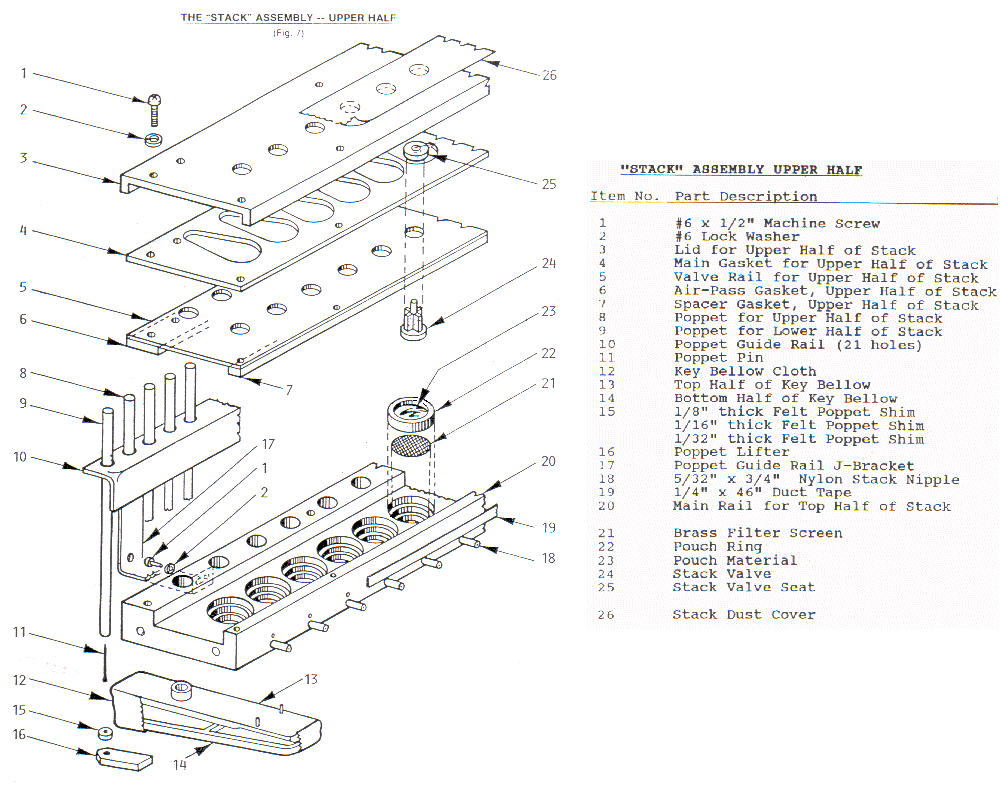
To explain this problem more concisely, you need to understand that inside of the stack (see diagram below) there is a small diaphragm (or pouch #23 -see diagram below) which is designed to sense the perforation in the paper music roll and convert it to a mechanical movement. This most basic principle of operation, which is used in every pneumatic player piano to make notes play and to operate other functions, is explained in detail in the "My Book" web page at Player-Care.com. |
|
If you read the explanation of how pouches and bleeds work together to create the mechanical movement which activates a valve, then I can proceed. In the case of a failed pouch in a Universal player, what happens is that the pouch material cracks. (I'll address why that happens below.) When it cracks, that allows atmosphere to pass through the trackerbar nipple into the stack. And, that rushing of air through the nipple creates the audible hissing sound you can hear in the video. Under normal circumstances, when the pouch is intact, the amount of atmosphere that enters through the nipple and into the pouch well is limited by the tiny bleed. That small amount of moving air is not sufficient to create an audible sound to the naked ear. In fact, in order to hear the moving air, you must use some type of listening device like a stethoscope or a listening tube (which is a length of trackerbar tubing with one end plugged into your ear). The reason the Perflex pouches crack is because the material is adversely effected by hydrolysis; a chemical reaction in which a substance reacts with water so as to be changed into another substance. In this case, the water reacts with the plastic and makes it stiff and brittle. After years of exposure to the moisture in the air, the otherwise clear Perflex material turns a milky white color (see below). And while the pouch may operate for a number of years after it has changed color, it WILL fail eventually. So, when one or more notes in a modern Universal fail, it's just a matter of time before all of them will have to be changed. The whole job takes about 16 hours.
Or access the video at YouTube "here"
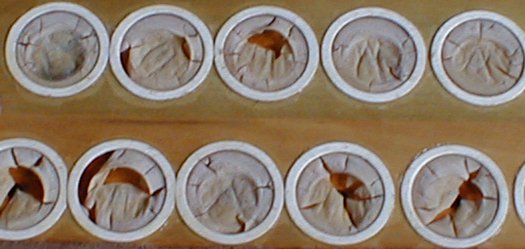 As a note of interest, the company that bought the rights to the Universal design tested numerous other synthetic pouch materials before settling on a new material called Tuftane. The company then produced a few thousand units with Tuftane pouches. Sadly, they too proved to be problematic, and the company stopped using synthetic material and started using the time-tested tan pneumatic leather that had been used since player pianos were first made over 100 years ago. Today, those of us who rebuild these stacks for a living use pouch rings that are covered with 0.008" tan pneumatic leather. It's also very advisable to replace the valve seats at the same time the pouches are changed. That is because the original seals were made from neoprene, and it was found that the neoprene would stick to the aluminum if the instrument was not used regularly. Then, when the unit was put back in service, tiny bits of the neoprene would break off the valve seat and stay stuck to the aluminum. This would lead to valve leakage when the valve rotated to a different location because the tiny piece of neoprene debris would prevent the valve from sealing 100%. The Setup Procedure Lastly, it should be noted that the 'hissing sound' created by the large amount of air flowing into the pouch well is so great that you can actually hear the sound at the trackerbar with the 'naked ear'. (It's even easier to hear the noise with a listening tube.) However, in order to do that you must first isolate the suspected defective note by covering the 'bar' with some type of tape. You must also activate the 'on-and-hold' switch (see diagram below -colored in blue) that rests in the grove on the take-up spool. That can be done by taking a piece of tape and taping the armature to the metal plate above or behind the take-up spool (whichever is more convenient). After the above two steps are completed, then turn the system 'On' by activating the Pump switch -as you would normally do when playing a music roll.
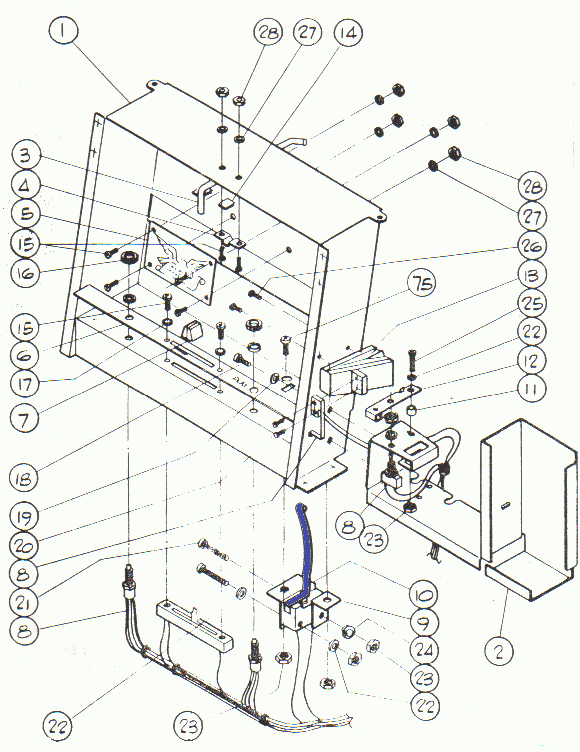 Click Here for Full Size Image of the Spoolbox Click Here for Full Size Image of Spoolbox Assembly Parts List
This video is self-explanatory
We Gladly Accept These Cards
For The Accuracy or Validity of the Statements and/or Opinions Expressed within the Pages of the Player-Care Domain. Cartoon Graphics by "Eric Styles"
SSL Certificates |