
|

|
|
|
|
|
|
| Home | Manuals | Supplies | Search | Consult | Contact | Testing | Service |
Technical Manuals .. (click here) Test your 'Player'.. (click here)
|
Chic from Pennsylvania writes, "Any advice on removing the existing cloth would be appreciated."
As I told Chic, "I'm actually surprised that I don't already have a web page devoted to removing old cloth." There are numerous techniques, and picking the right one can mean the difference between doing an excellent job and having to replace the wood. It's that important! The one I'll start with is one for medium sized bellows.
If time is not an issue and top notch quality is your aim, the best method for removing old cloth from a medium sized bellows involves paper towels, a pan that's bigger than the bellows, and water. That's it! Ideally, everything that's attached to the bellows has been removed, so that all you have is two pieces of wood that are covered with old bellows cloth. However, the process will work as long as all of the edges of the bellows can touch a flat surface. First, measure the span of the bellow. Next, with a sharp knife, cut away all of the cloth except for what is on the edges of the bellow. Second, take three or four regular paper towels and saturate them with water. Then squeeze out just enough of the water that no water will drip off the wet towels when they are opened back up. Next, fold as necessary to fit the pan. Third, place the wet towels in the pan and rest one of the edges on the towels. (I have found that saving the hinged end of the bellows for last works best.)
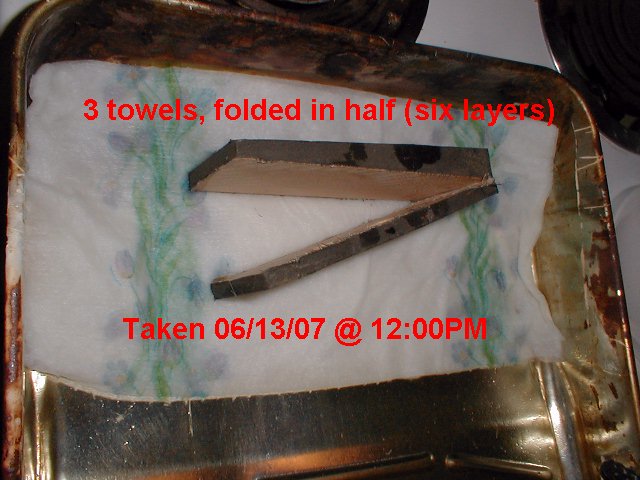 Fourth..... Wait for about 20 minutes. This is where judgment and testing come into play. After some length of time, the water will soak the old cloth well enough that the hide glue under the cloth will soften. Once that happens, the cloth can be peeled off with virtually NO effort. If you're impatient, when you go to peel off the cloth, only some of it will come off. Then you have to let it soak a little longer. Once the cloth has all been peeled off, use a straight edge and gently scrape off the wet glue and any glue that's on the inside of the bellows (by that edge). Continue the process for all four edges. My favorite method for testing to see if the cloth is ready involves my knife blade. After about 25 minutes, I first look at the wood to see if it's wet looking. If it is, then I gently try to work the blade in between the cloth and the wood, near one of the ends. If it slips right under all the way, I cut the cloth at the end, reverse the knife edge and place it between the cloth and the wood where I initially slipped the blade in between the cloth and the wood. Then, holding the cut end of the cloth fairly taught, I wiggle the knife forward and backward (like a lever - not like sawing), up the edge to the opposite end. If it resists coming off, I recommend that you not try to force it off. Just let it soak awhile longer. Sometimes you can just pull off the cloth, but sometimes it will rip, and then you have to soak it some more anyhow, and the 'exposed' wood will get unevenly wet, which could lead to warpage. 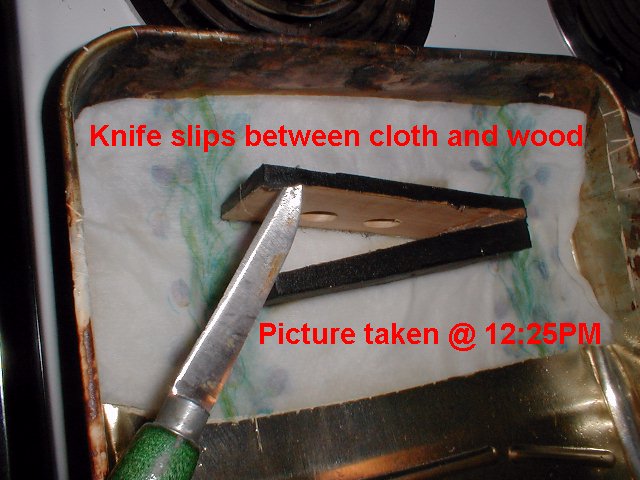 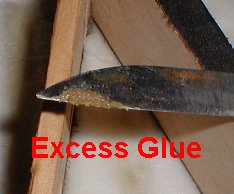 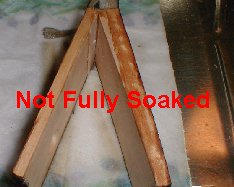 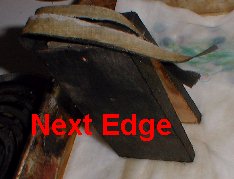 Most simply put, this method uses what is known in science as "capillary action". What this means is that the water doesn't necessarily soak through the face of the air-tight material. In fact, most of the water gets under the air-tight material by entering at the edges where the material was cut away. Then, over a period of time, the water follows all the dry fibers of cloth and attempts to get them wet. It is for this reason that judgment is required with regards to when you should attempt to begin removing the cloth. All cloth is different, and the amount of glue that was used to glue the cloth to the wood is different. Therefore, the amount of time it takes to loosen the glue will likewise be different. However, you don't really want the wood to stay wet for any longer than is necessary. Doing so could lead to slight warpage. The beauty of this method is that it is basically effortless. However, the really gorgeous part is that NO wood is lost during the removal of the old cloth. And, as all professional rebuilders know, the first rule of thumb in quality restoration work is: DO NO HARM! Any method that involves sanding or scraping is bound to cause some degree of damage to the wood. Also, check out the YouTube video about removing the cloth with a heat gun at: https://www.youtube.com/watch?v=p-enoPaIjhY
In this day and age, it's not at all uncommon to find that the bellows cloth was glued to the wood with a white or aliphatic. These glues are generally NOT "water soluble". Once I've pulled off as much of the old cloth as possible, I recommend using 3M Adhesive Remover 3M-03618 to remove as much of the old glue as possible. I spray it into the cap and paint it on the surface to be cleaned. Then let it soak in and gently scrape off the glue (before the cleaner dries or evaporates).
|
We Gladly Accept These Cards


|
Since "Player-Care" is an internet business, I prefer that we correspond via E-Mail (click here to fill out the 'Request Form'). However, if I'm not in the middle of some other activity, you can reach me at 732-840-8787. But please understand that during the hours from 8AM-5PM EST (Mon-Sat), I'm generally quite busy. So, I probably won't answer the phone. If you get the answering machine, please leave a detailed message stating the reason for your call. Also, repeat your name and phone number clearly and distinctly. By necessity, I prioritize everything in my life. And, if you call and just leave your name and number, and ask me to call you back, it might be a day or two before I return your call. Why? Because I don't know why you want me to call and I might not be prepared to assist you in an effective and efficient manner. If you leave me an E-Mail address (which I prefer), spell it out phonetically. The more you do to help me, the more I can help you in return. Don't rush. You have four minutes to record your message. |
  |
407 19th Ave, Brick, NJ, 08724 Phone Number 732-840-8787 (Voicemail Only, No Texts) |
  |
